 These
two weapons are probably the oldest hunting tools (after spears and knives)
that have survived till the present. Simple-looking, modern longbows and
recurves employ some of the modern-day technology to make them meet the
demands of the modern hunters. Still, these bows are pretty much the same
as those our ancestors used way before the powder was invented.
These
two weapons are probably the oldest hunting tools (after spears and knives)
that have survived till the present. Simple-looking, modern longbows and
recurves employ some of the modern-day technology to make them meet the
demands of the modern hunters. Still, these bows are pretty much the same
as those our ancestors used way before the powder was invented.
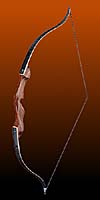
These simple bows consist basically of just two parts: bow itself (with hand grip and two limbs) and a string. The hunter shooting such bows holds the full weight of the string while aiming, therefore these bows require considerable strength and skill for successful hunting (Browning Wolf pictured).
 Compound
bows are more complicated than longbows and recurves. There are several
types of compound bows, differing in construction. Main elements of compound
bows are limbs that are attached (rigidely or hinged) to the hand grip
of the bow, string and a system of blocks, or cams, which redistribute
the draw weight to the limbs and increase draw weight compared to that
of a longbow of the same size. Cams are made eccentric to reduce the effort
required from a bowhunter to hold the string while aiming or waiting for
a shot (so-called let-off, specified in percent of the total draw weight).
Compound bows include other elements that make bows better balanced, increase
aiming accuracy and reduce noise. Typically, the weight of the string on
modern bows can be adjusted and ranges from 30 to 80 lbs and compounds
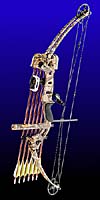
are capable of speeds up to 300 fps (Browning Afterburner pictured).
Compound
bows are more complicated than longbows and recurves. There are several
types of compound bows, differing in construction. Main elements of compound
bows are limbs that are attached (rigidely or hinged) to the hand grip
of the bow, string and a system of blocks, or cams, which redistribute
the draw weight to the limbs and increase draw weight compared to that
of a longbow of the same size. Cams are made eccentric to reduce the effort
required from a bowhunter to hold the string while aiming or waiting for
a shot (so-called let-off, specified in percent of the total draw weight).
Compound bows include other elements that make bows better balanced, increase
aiming accuracy and reduce noise. Typically, the weight of the string on
modern bows can be adjusted and ranges from 30 to 80 lbs and compounds
are capable of speeds up to 300 fps (Browning Afterburner pictured).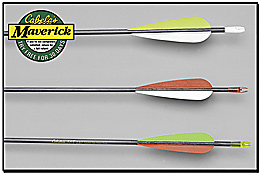
 Modern
hunting arrows are made from aluminum (or other light metal) alloys, carbon
fiber or a composite of the two. They are exceptionally straight and lightweight,
thus providing for higher velocities and flatter trajectories. Arrow shafts
have female threaded ends where an appropriate arrowhead can be installed.
Traditional feathers stabilizing an arrow are now made of lightweight plastics
and are installed at a slight angle to give an arrow some rotation, stabilizing
it similarly to a rifle bullet.
Modern
hunting arrows are made from aluminum (or other light metal) alloys, carbon
fiber or a composite of the two. They are exceptionally straight and lightweight,
thus providing for higher velocities and flatter trajectories. Arrow shafts
have female threaded ends where an appropriate arrowhead can be installed.
Traditional feathers stabilizing an arrow are now made of lightweight plastics
and are installed at a slight angle to give an arrow some rotation, stabilizing
it similarly to a rifle bullet.